




FASST-CH in the Cockpit – Federal Support
As part of the «FASST-CH» program of the Federal Office of Civil Aviation (FOCA), the DETEC Ordinance on Traffic Rules for Aircraft (VRV-L) is being amended, among other things. To be eligible for federal support for necessary investments in cockpit equipment, a response must be submitted by November 30, 2027, at the latest.
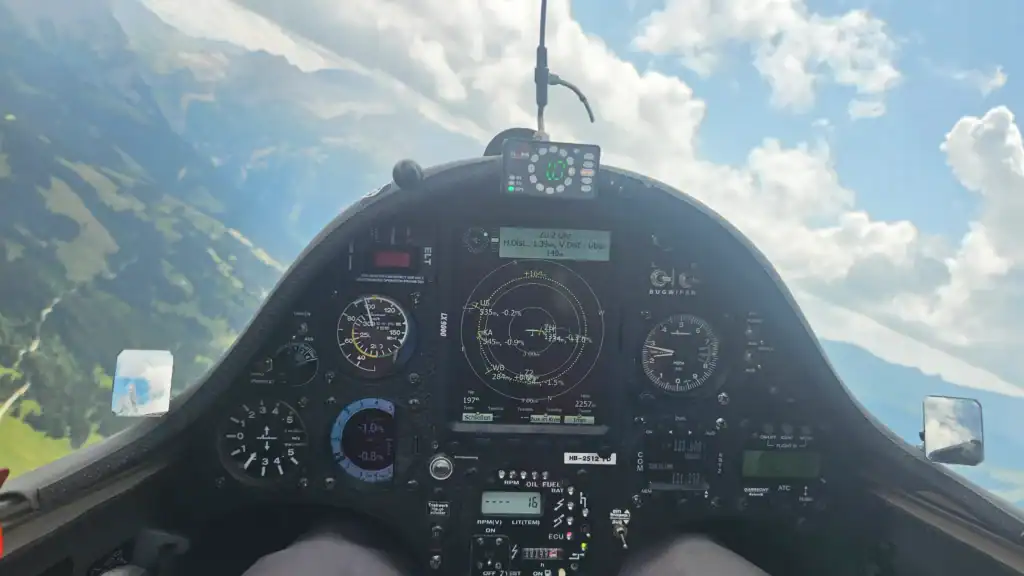
Author: Chrigel Markoff, Photo by Felix Deutsch
The project has been running for several years now. FASST-CH Program by the federal government. The goal is to ensure that, by the end of 2028, all traffic in Swiss airspace will be electronically visible. To this end, two measures are to be implemented:
1. Article 29 of the VRV-L is to be extended to cover gliders and balloons. Aircraft that do not yet have a transponder must be equipped with one in the future.
2. In the future, all aircraft operating under VFR must be equipped with technology that makes them electronically visible, based on technologies prescribed by EASA for the implementation of SERA 6005(c).
What does this mean, specifically, for aircraft operating under VFR?
a) For gliders and balloons:
Gliders and balloons must now be equipped with at least one Mode S transponder. If this transponder already supports ADS-B Out, no further action is required. If not, the transponder must either be upgraded to ADS-B Out, or an ADS-L device must be installed, unless one is already present.
b) For powered aircraft:
Motorized aircraft whose Mode S transponders are not compatible with ADS-B Out must either upgrade their transponders to ADS-B Out or install an ADS-L device, if they do not already have one.
The costs may be partially funded by the federal government:
Through the Special Air Transport Funding Program (colloquially known as «BV87 support»), the FOCA provides substantial financial support for various technologies that can be used to meet the required obligation. This applies in particular to the retrofitting of an existing Mode S transponder with an ADS-B Out function, the installation of a new Mode S transponder with an ADS-B Out function, or the installation of ADS-L equipment.
However, for an application for financial support to be approved, the measure must be voluntary and may not relate to equipment for which a legal obligation applies after its release.
However, applications may also be submitted for installations planned for a later date. There is therefore no reason not to submit an application in November 2026, even if the installation date is not yet known. It should also be noted that Mode-S transponders without ADS-B Out functionality are not eligible for financial support.
For applications for financial support for additional cockpit equipment, the FOCA provides a simplified and partially pre-filled form. This must be submitted to the FOCA by November 30, 2026, along with a quote, cost breakdown, or similar documentation. Even though a simplified procedure applies to the submission of these applications, it is recommended that you begin preparing the documents as early as possible to ensure timely submission. Further information is available at Specialized Financing for Air Travel can be found on the FOCA website.
Forms DE
Budget Projections: Final Figures
Forms FR
Budget Projections: Final Figures
IT Forms
Budget Projections: Final Figures

FAQ (currently being expanded):
We have equipped all of our aircraft with Mode S transponders and at least ADS-B Out. However, we still have a few Garrecht VT-01 Mode S transponders with ADS-B Out capability (non-certified SIL=0/SDA=0) in use. This raises the question of whether the GPS position data—the »Signal Integrity Level,« or SIL for short—must be greater than 0, or whether a non-certified SIL=0 is sufficient. This is not specified by the FOCA. If so, gliding operations would face significant costs, as either other devices (ADS-L) would have to be installed or the transponders would have to be replaced.
(FOCA Response) SIL 0 and SDA 0 are sufficient. Otherwise, this would not be consistent with the fact that ADS-L (also 0/0) is sufficient. The protection of commercial IFR traffic is ensured by Mode S, not by the ADS-B component of the installation.
When can we begin implementing the measure?
It is important to submit the complete application before beginning to implement the measure (e.g., ordering and installing the equipment); otherwise, the FOCA cannot award financial assistance. See the FOCA website For more information on this.
What ADS-L devices are available?
We will publish a list of available devices in due course.
Can I wait until next year to buy and install a device?
Yes, but the application for co-financing must be submitted to the FOCA by November 30, 2026, in any case.
After submitting a complete application, can I already begin early installation, even if I haven’t yet received approval for the application?
Yes, that's possible, but at your own risk. If the decision is negative, I'll have to cover the costs myself.
Can existing devices be upgraded, and is this upgrade also subsidized?
Yes. Mode S transponders can be upgraded to ADS-B or ADS-L. Similarly, FLARM devices, for example, can also be upgraded to ADS-L. The special financing program supports the installation of all equipment and technologies required for retrofitting and upgrading to ensure mutual electronic visibility of Swiss aircraft. If no retrofittable devices are installed, new devices with the required functions must be installed.
Does my glider also need a transponder if it's used exclusively for traffic pattern flights and similar operations?
No. The new version of Article 29 of the VRV-L requires a transponder only at altitudes of 7,000 ft AMSL and above. However, we do not expect there to be many aircraft that will operate exclusively below this altitude.
Are there any exceptions for historic gliders?
Yes, the FOCA still needs to define the exceptions for historic gliders.
I'd be interested to know why the FOCA insists on 7,000 ft for turning on a transponder in VFR traffic. The risk of failing to spot an aircraft is even greater below 7,000 ft. In my opinion, the transponder should be turned on for the entire flight. Glider pilots should also be required to always turn on their FLARM and transponder, even during competitions of any kind.
Is there a reason why only «permanently installed» ADS-L devices are eligible for financial support?
There is the stand-alone PowerFlarm Flex, which can be installed very easily and inexpensively in any sailplane or motorized aircraft (without any modifications to the cockpit). This device is already ADS-L-capable and can be activated soon via a software update (according to the manufacturer).
Furthermore, I don't understand why the application must be submitted by the end of November 2026, even though it is not yet known which devices will meet the future FASST guidelines.
Special financing BV87b is available for ADS-L devices (first item on the form, Section 2.1), including both portable and permanently installed devices. Therefore, the purchase of the device in question should also be eligible for financial support.
By law, BV87 funds may only be disbursed if a measure is voluntary. Once the new regulation takes effect in 2027, such a measure will no longer be voluntary and will therefore no longer be eligible for support. And because applications must always be submitted by the end of November for each period, this must be done by November 30, 2026.
How can the problem of insufficient battery power in gliders be solved?
This issue has not yet been resolved. However, based on statements from the Gliding Association, we assume that only a very small number of extremely long flights are now affected. During the public consultation—expected to take place at the end of this year—such concerns and comments can and will be submitted to the FOCA.